
Teaching Greek and Latin Roots Without Boring Your Students
Words like biology, astronomy, therapy, and philosophy all have something in common.
They’re built from Greek and Latin roots.
Once students start recognizing those roots, something really powerful happens: they stop feeling completely lost when they encounter unfamiliar words.
Instead of guessing randomly, they can break the word apart and figure out the meaning.
That’s why I love teaching Greek and Latin roots in middle school. It gives students tools they can use across reading, writing, and content areas.
But here’s the problem…
Most vocabulary instruction still looks like this:
A giant list of words.
Students copy definitions.
Maybe they write each word three times.
And by the end of the week?
They’ve memorized a few definitions for a quiz… and forgotten them by the following Monday.
Middle school students need more interaction than that.They need to see the words, use the words, draw the words, and interact with the words multiple times before the meaning really sticks.

The Real Problem With Vocabulary Instruction
Here’s what I started noticing in my classroom.
My students could memorize vocabulary definitions for a quiz… but a week later they had no idea what the words meant when they showed up in a passage.
Sound familiar?
They weren’t actually learning the words — they were just temporarily storing the definitions long enough to pass the test.
And for struggling readers, the problem was even bigger. A long list of unfamiliar words just felt overwhelming.
They needed more than definitions.
They needed to see the words, use the words, draw the words, and interact with the words multiple times before the meaning would actually stick.That’s when I started building a vocabulary system that used visual learning, repetition, and context instead of just memorization.
Why Greek and Latin Roots Matter
A huge portion of the English language comes from Greek and Latin.
In fact:
• Over 60% of English words have Greek or Latin origins
• That number jumps to over 90% for academic and scientific vocabulary
When students understand common roots, prefixes, and suffixes, they gain a huge advantage.
Instead of memorizing thousands of isolated vocabulary words, they begin to recognize patterns.
For example:
bio = life
astro = star
therm = heat
Once students understand those roots, they can unlock the meaning of dozens of related words.This approach also aligns with research from the Science of Reading, which highlights the importance of morphology instruction. When students understand how prefixes, suffixes, and Greek and Latin roots combine to form words, they gain powerful tools for decoding unfamiliar vocabulary and improving reading comprehension.
How the ELA Content Hub Vocabulary Units Work
Inside the ELA Content Hub, the Greek and Latin roots curriculum is organized into thematic vocabulary units.
Each unit focuses on a group of roots connected by a theme.
For example:
• Life and living things
• The stars and space
• Healing and medicine
• Light and vision
Grouping the words this way helps students make connections instead of memorizing random lists.
A Simple Weekly Vocabulary Routine
One thing teachers love about the vocabulary units is the predictable weekly routine.
Students interact with the words multiple times throughout the week, which improves retention and helps the meanings stick.
Here’s what a typical week might look like:
Monday
Introduce the roots and vocabulary words with the mini-lesson PowerPoint and word list.
Tuesday
Read the vocabulary passage and identify how the words are used in context.
Wednesday
Complete the doodle definitions page to visually represent the meaning of the words.
Thursday
Practice with word play activities, flashcards, or the crossword puzzle.
Friday
Review the words and complete the vocabulary assessment.This routine keeps vocabulary instruction structured, predictable, and engaging for students.
What’s Included in Each Vocabulary Unit
Mini-Lesson PowerPoint
The week begins with a short mini-lesson introducing the roots and vocabulary words. The slides are clear, visual, and easy for students to follow.
Word Lists and Definitions
Students receive a list of vocabulary words built from the target roots, along with student-friendly definitions.
Reading Passage
Each unit includes a reading passage that uses the vocabulary words in context. This helps students see how the words function in real sentences.
Doodle Definitions
Students create visual representations of the vocabulary words.This activity works especially well for struggling readers because it turns vocabulary into a visual memory instead of just text on a page.
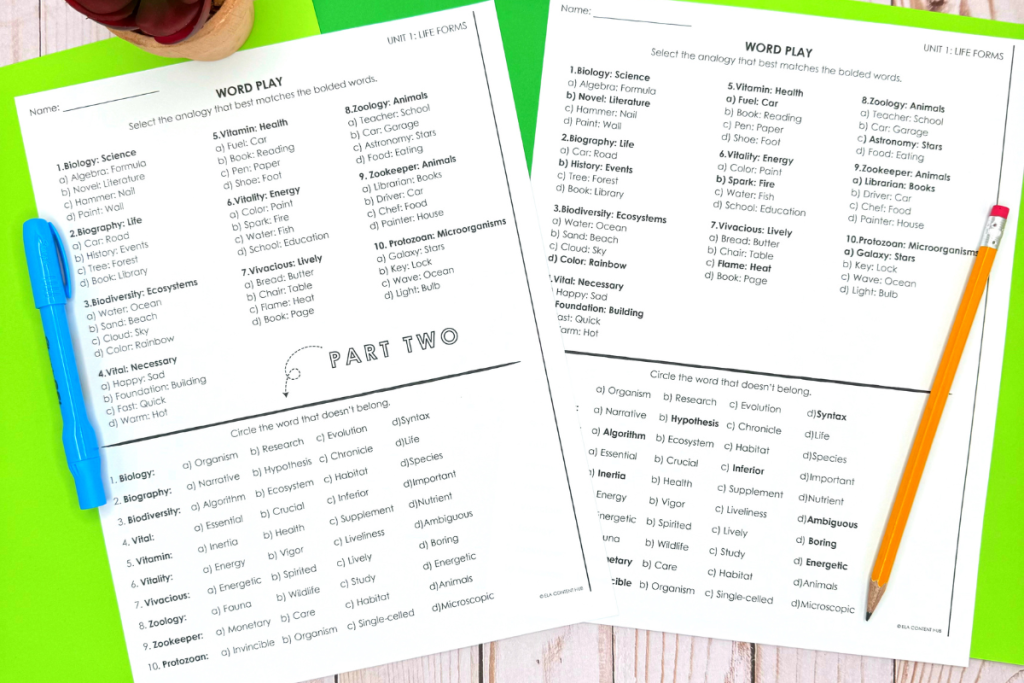
Word Play Activities
Students practice the words through games and interactive vocabulary activities that reinforce meaning.
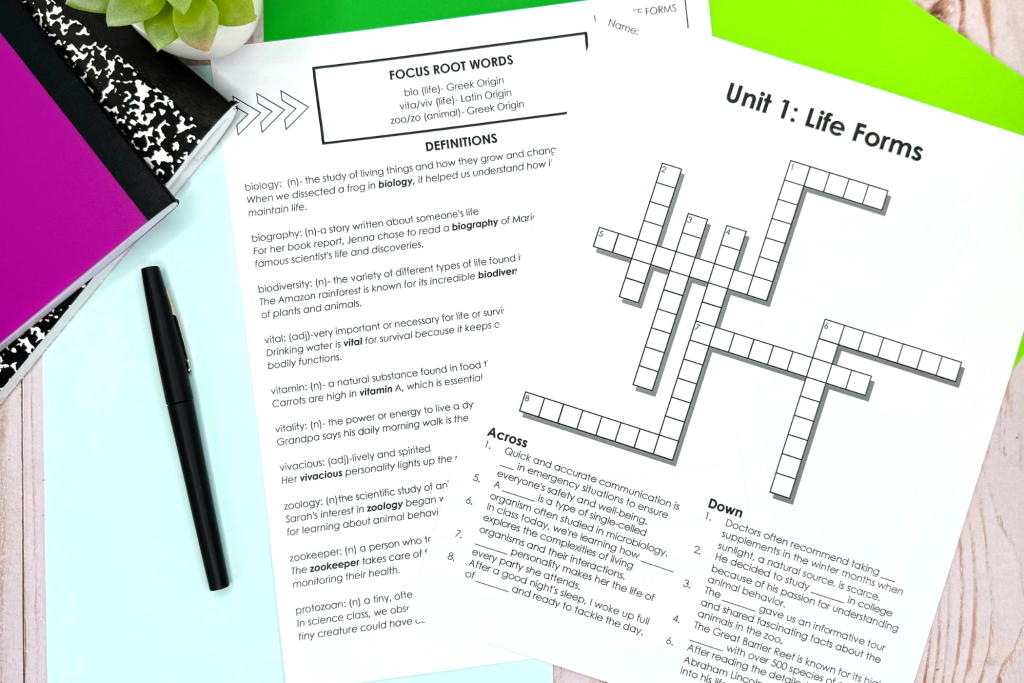
Crossword Puzzle
The crossword puzzle challenges students to recall definitions and recognize root meanings in a fun format.
Flashcards
Flashcards can be used for:
• partner games
• quick reviews
• vocabulary challenges
• small group practice
Assessment
Each unit ends with an assessment so teachers can quickly check for understanding.
Why These Activities Work (Especially for Struggling Students)
Traditional vocabulary instruction often relies heavily on memorization.
But struggling readers benefit from multiple exposures and multiple learning formats.
That’s why the vocabulary units include:
• visual doodle activities
• reading passages
• games
• puzzles
• flashcards
Students encounter the words several times throughout the week, which helps the meaning stick.
Easy Implementation for Teachers
Teachers already have enough on their plates.
That’s why each vocabulary unit is designed to be plug-and-play.
You can open the unit on Monday and have everything you need for the entire week.
No extra prep.
No searching for activities.
No building vocabulary lessons from scratch.
Just clear instructions and ready-to-use materials.
Want a Simple Vocabulary System That Actually Works?
If you’ve ever felt like vocabulary instruction turns into a cycle of memorizing definitions and forgetting them a week later, you’re not alone.
That’s exactly the problem I wanted to solve when I created the Greek and Latin Roots Vocabulary Units inside the ELA Content Hub.
Instead of scrambling for vocabulary activities each week, you get a complete system that walks students through learning, practicing, and applying the words.
Inside each unit you’ll find:
• mini-lesson slides
• student word lists
• reading passages
• doodle vocabulary pages
• flashcards
• word play activities
• crossword puzzles
• assessments
Everything is organized and ready to teach.
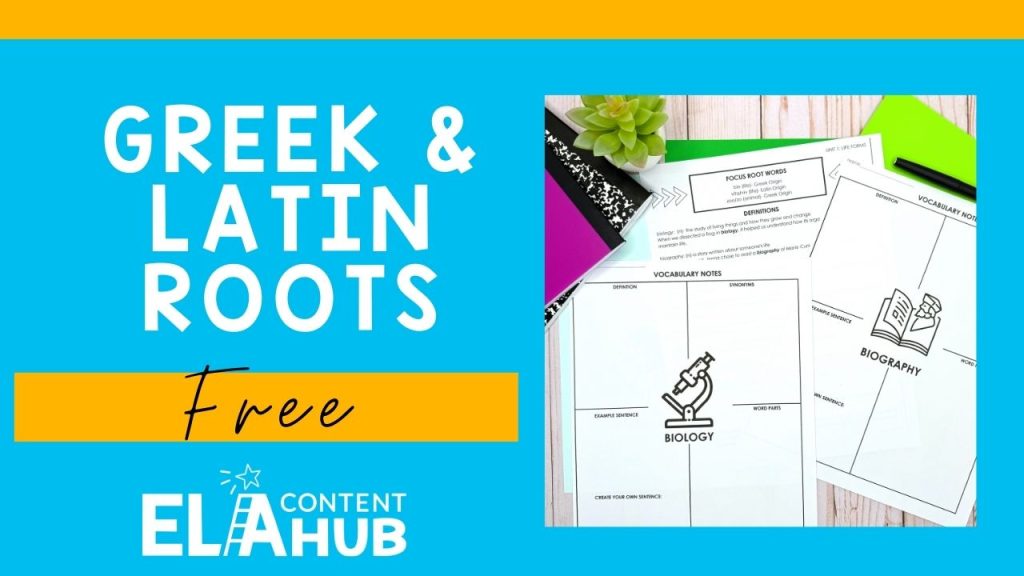
Try One Week Free
If you’d like to see how the vocabulary system works in your classroom, you can try one week for free! Click the links below to download.
Unit 1 Focus Roots: bio, vita, zoo
Activities Included:
I’ve had my eyes on these for awhile and am esp interested as we are moving away from chromebooks this year. However, my students are mostly on the higher end, and I’m concerned they will speed through the work too quickly. Have you had this issue?
That’s a great question! My students don’t seem to rush through it. Higher-level students may move through the initial work more quickly, but you can extend their learning by having them apply the roots to unfamiliar words, use the vocabulary in context, or look for examples in their independent reading.